
At lunchtime on 6th June, a ‘moderate thunderstorm warning’ flashed up on my lockscreen, courtesy of the MetOffice. These warnings started appearing some time in 2024. I remember finding the first one exciting, but after the fifth ‘amber alert for rainfall’ and the third accompanying ‘strong wind warning’, they became a bit pedestrian.
Cornwall is almost always a bit damp; that’s what makes her landscape so exciting. Palm trees and echiums thrive thanks to the rain, the subtropical climate, and the high humidity levels. But so does the mould that weaves its way across any manmade structure that you can think of: houses, flats, pubs, and of course, boats.
The first morning we awoke on Lowenna, the air was thick. I took a deep breath and almost choked on tiny particles of moisture that hung in the air and clung to every exposed surface. Our little log-burner and a dehumidifier helped, but you couldn’t ignore the black blossoms that flourished on our uninsulated vinyl ceilings.
You couldn’t see the more sinister blooms that festered behind the fuzzy, carpeted walls of the V-berth, where we slept.


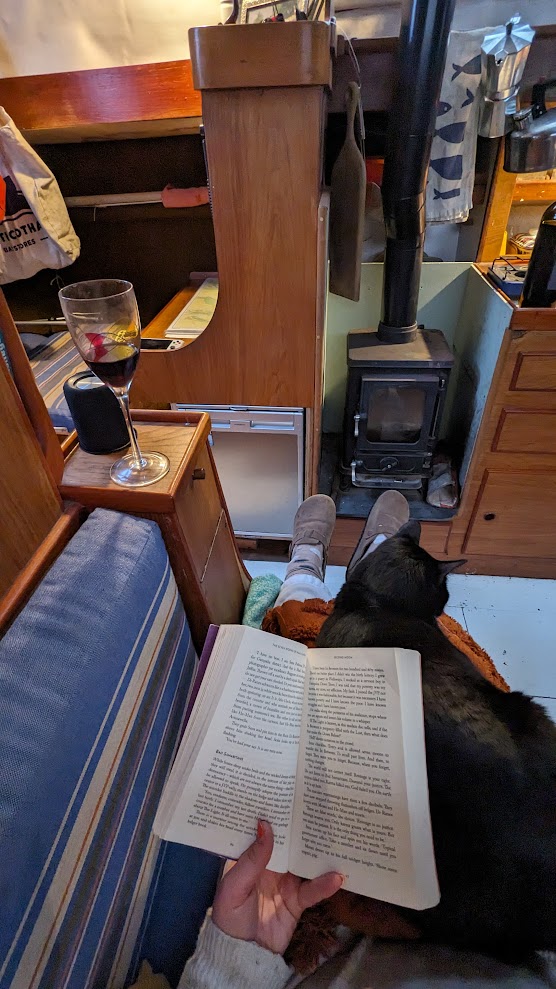
It took stripping out the 47-year-old coverings, getting back to the raw GRP (glass reinforced polyester) and Jason cleaning spikes of mould that stood like stalagmites out of our pilot berth for us to realise how much dampness was affecting Lowenna.
We spent days researching different ways to lock warmth in and water out. We dried out the walls and, for the first time since 1978, insulated the entire cabin. We slathered our coach roof in insulation foam and Jason mixed flowcoat for our ceilings. This gel-based mixture acts like a barrier, stopping rain from sneaking in through the surprisingly porous fibreglass walls. It’s also a material that requires a gas mask to use, and that is liable to explode if it’s not measured accurately – Jason quite seriously told me that if I heard the paint tray fizzing to just throw the whole thing into the sea.
We needed to think carefully about what we would use to cover the flowcoat and how it would affect our living space. We considered cork – which absorbs moisture and allows for easy decoration – but couldn’t find panels that would bend around Lowenna’s curves and contours. We explored tongue and groove wood panelling, which Jason’s Dad had fitted beautifully to our coach roof, but it didn’t have the necessary flexibility for the walls. It needed to look clean and bright, and not be a breeding ground for fungus. Enter leatherette. Malleable, easy to cut to shape, wipe clean, and lined for warmth.
If you, too, want to have a crack at reupholstering a small space – boat, van, caravan – these are the steps that we took to make our space feel fresher and safer.
- Measure and cut out your material:
- You’ll need to know the rough surface area, which we got ourselves in a right muddle trying to work out. If you are replacing old material, like we were, hold onto the original as a template and draw around it so that you don’t have to do as much calculating and figuring.
- Using a craft knife or Stanley knife, cut out your shape, giving yourself some excess – we did a few centimetres either side. This can be trimmed away once the material is attached.
- Clean down the walls as much as possible:
- Dirt and old gunk can make it more difficult to affix new material because of the uneven surface, and if you’re using a softer material like leather or leatherette, it could exaggerate those lumps and bumps.
- Give your walls a good scrub down and get as much excess dirt off as you can before you start working again.
- If you’re on a boat, flowcoat your walls:
- Flowcoat requires mixing of chemicals that are both corrosive and explosive, so make sure they are mixed by someone who knows what they are doing.
- Once mixed, it will be a thick mixture and will absolutely leave streaks if you are using a brush. Make sure that every surface is covered, leaving no exposed walls. It begins to ‘go off’ quickly and will become tacky – repainting over this will just make it peel off, so one thick coat is fine.
- The space needs to get to at least 17 degrees Celsius for it to cure. Give it a day or two at least. If you are worried about the temperature or dampness, you can always leave a dehumidifier running to help it along. Once the walls are more-or-less dry to the touch, you’re good to go.
- Line up the material and pin down to check:
- We used the material we had taken from the wall as a template, and we still needed to do some checking and aligning. Do not rush in and assume it will be perfect. Use something to attach your material to the wall temporarily and make sure that everything lines up.
- Windows are helpful as a marker for aligning, and wall staples are great for attaching temporarily – the staples are remarkably easy to remove.
- Push the material flat to the wall for a final check:
- You don’t want to end up with walls that look like a pair of leggings that have lost their elastic.
- Start affixing your material:
- Using a quick dry spray trim adhesive, spray directly onto the wall – not the material – in small sections.
- Press down with your hands for warmth and smooth carefully to ensure your material is tight.
- Using something large and flat, smooth the material against the wall again to remove any air pockets. I used a book for large flat spaces, and an old power bank for a phone we had knocking around for more awkward ones.
- Go slowly, spraying and smoothing to ensure there are no bubbles or gaps.
- Make sure you’ve got something quick-dry but not instant so, if needed, you can peel back and reapply to make sure it looks fresh.
- If you have awkward walls, eg. The V-berth, which is curved and narrows at the far end, start at the narrow end and give yourself plenty of excess material.

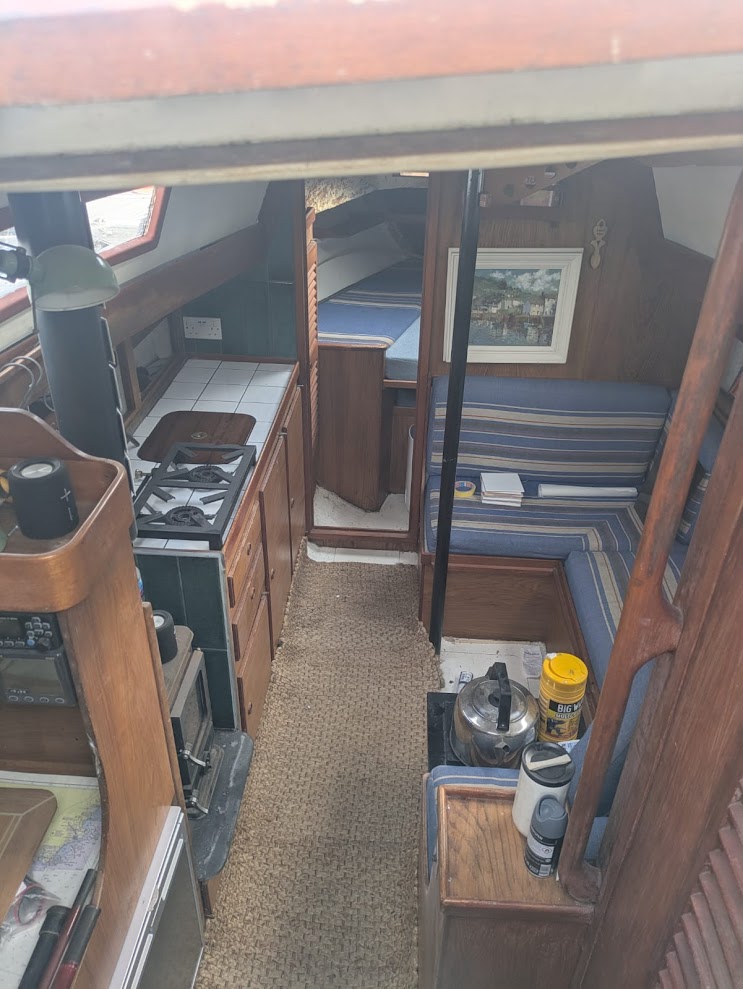

I haven’t woken up choking on damp air since reupholstering. There are no longer sinister marks flourishing at my eye line as I lie in bed, and there is a freshness and modernity to Lowenna that I didn’t think you could bring into a boat from the late ‘70s. Life is all about balance, and you know what your space needs more than anyone else. If you give reupholstering a go, let me know how your home feels after.
 Roots and Mooring Lines
Tell me what you think!